 |
|
|
|
|
| The mate change |
|
|
If you are new to problem solving |
| Sam Loyd, the
American wizard, once wrote "My idea of a key-move is what 999 out of 1000 players
would look for" and his most popular problems proved this point. He
had an infallible
knack of guiding the solver down the wrong path without the solver perceiving
it. Of all
those little points that conceal the composer's intention, the foremost which comes to my
mind are the mates provided in the diagrammed position for certain strong and obvious
black moves. The Good Companion Two-move Club spearheaded by Alain White at the turn of
the century was devoted to producing refined problems involving predominantly the post key
play of two-movers. This was followed by problems extending beyond the play following the
key. The virtual or try play, set play, changed play, mate transference were some of the
early innovations in the modern two-mover. The 'Changed mate' is the most popular one
employed in almost all the modern themes. |
What is a
changed mate? For this we must understand as to what is set play. In the diagram of a
problem if it is black's turn to play and if some mates are provided for particular black
moves, such mates are termed SET MATES and the play following the black moves in the
diagram position is set play. Let us have a look at a simple changed mate problem. |
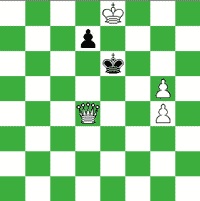
Mate in two moves |
Solution
There are
only two black moves in the diagram and mates follow
if it is black's turn to play. 1.d6 2. Qe4 mate and 1.d5 2.Qf6 mate.
Both these are called set mates. We are unable to hold the position with a
waiting white move so that the same mates can be retained. For example
1.Kf8? loses control of d7 for both the mates. The key changes both the
mates after the same defences.
1. Qc5!! 1.d6/d5 2.Qf5/Qe7.
|
| Here
the mates for all the available black moves are changed. Such complete block changed mate
problems are called MUTATES. It is not necessary that all the mates provided in the set be
changed as in the above example to qualify for a mutate. Solve the problem below by
Gorislavski where only a few of the mates are replaced. However all the black moves are
provided with mates in the set. The interesting part of the problem are the tries by the
white bishop |
Mate in two
moves 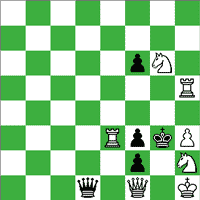
A.Bottachi, I pr,Good Companion 1920 |
| In
certain problems changes are effected selectively for prominent black
defences. In the
problem above, the defences 1.Qc1/Qe1 and 1.QxQ+ are met by the mates 2.Rxf3 and 2. NxQ
respectively. When the WQ moves away from the first rank the unpinned WQ mates on g2. The
key 1.Nxf3!! threatens nothing but waits for black to play. Now after 1.Qc1/Qe1/QxQ the
mates are 2.Nd2/NxQ/Ng1. |
Problems
for solving
Look out for changed mates and indicate along with the solution, the set mate. |
| Mate
in two moves |

M.Gorislavski, 2nd Prize '64' TT, 1979
|

H.W.Grant, 1st Prize, Australian Column 1924
|
Solutions to the problem
in The elegant Cross-check
Problem 1 : Barry Barnes, Second Prize BCPS 1959 1.Kb3!
Problem 2 : M.Segers, First Prize Schachpelaren, 1933
1.Qf8! |
- C G S Narayanan |
More Problems |
Top |
Glossary
Symbol |
Meaning |
+ |
Check |
# |
Checkmate |
x |
Capture |
! |
Good
Move |
!! |
Excellent
Move |
? |
Bad
move |
??
|
Blunder |
!?
|
Interesting Move |
?! |
Dubious Move |
1-0 |
White Wins |
0-1 |
Black Wins |
1/2 |
Draw |
Twoer |
Mate in Two Moves |
|
Top |
| About
the author C.G.S.Narayanan, an
international composer of repute, has been composing Chess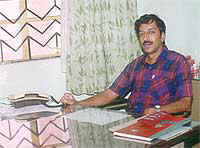 problems for the past thirty years. He has won several awards for his compositions in
International composing tourneys and he has an output of over 300 problems to his credit.
He is the second Indian to win the prestigious Brian Harley Award for the best two-mover
composed by a subject of British Commonwealth twice in 1977 and 1991. He has been editing
THE HINDU Chess problem column from 1982 onwards, after S.K.Narasimhan. He has captained
the Indian team in the World Chess Compositions Tournaments held by FIDE.
problems for the past thirty years. He has won several awards for his compositions in
International composing tourneys and he has an output of over 300 problems to his credit.
He is the second Indian to win the prestigious Brian Harley Award for the best two-mover
composed by a subject of British Commonwealth twice in 1977 and 1991. He has been editing
THE HINDU Chess problem column from 1982 onwards, after S.K.Narasimhan. He has captained
the Indian team in the World Chess Compositions Tournaments held by FIDE. |
More Problems |
Top |
|
|
|
|
|
You
can Contribute!!
|
|
You
are welcome to contribute to our site. You could send
us reports of tournaments in your region, analysis of your games or that of any other player. Or snippets,
happenings or anything of interest that will capture the browser
and the chess fan.
|
|
|

 World Top 100


